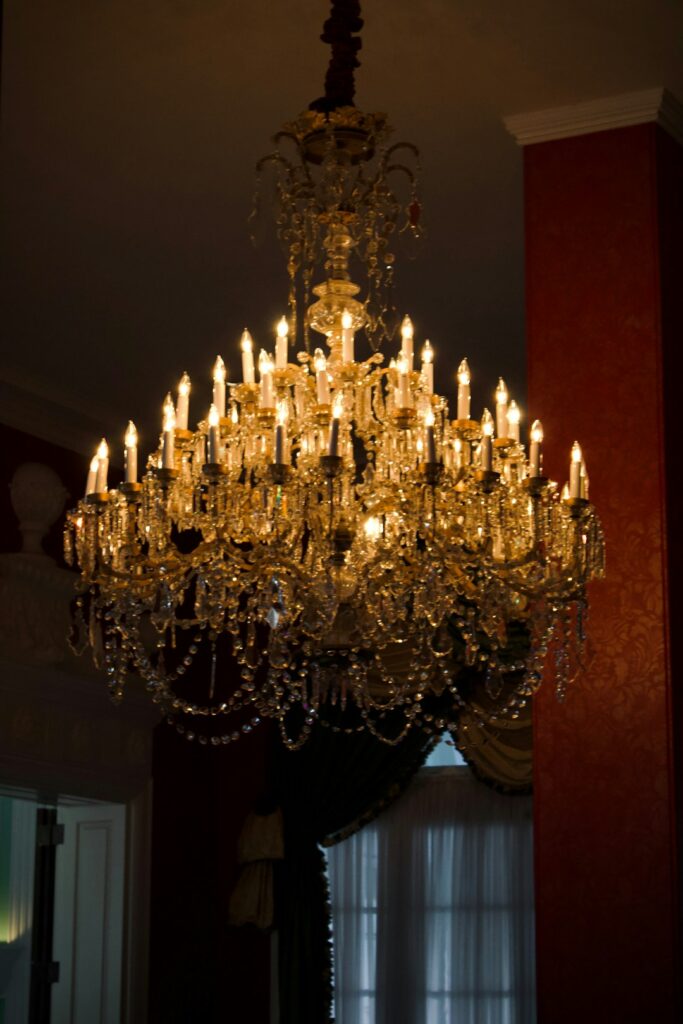

Scale and proportion are the first practical checks. A wide chandelier over a narrow table can dominate the room, while a small fitting above a long table may look accidental. I normally sketch the fitting in relation to the furniture and mark the intended hanging height, allowing enough clearance for conversation and movement. This is especially useful in a townhouse dining room, where a low ceiling and tall furniture can make a generous design feel oppressive. Reviewing examples of custom made crystal chandeliers can help clarify whether a circular, linear or tiered form suits the room.
The ceiling fixing is where attractive proposals can become expensive problems. A plasterboard surface is not automatically strong enough for a substantial fitting, and an existing rose may conceal wiring that is unsuitable for the new load. The safe approach is to identify the structural support above the visible ceiling and specify a suitable mounting plate or support bracket. Load refers to the weight transferred to that fixing, including the frame, crystals and any accessories. An electrician and, where necessary, a builder should agree the support arrangement before the ceiling is closed or decorated.
Crystal itself affects both appearance and light distribution. Faceted pieces bend and reflect light, whereas flatter or less heavily cut elements can produce a quieter glow. The frame finish also changes how the fitting reads in daylight, so samples should be viewed against the actual wall colours and fabrics. Colour temperature describes whether a lamp appears warm or cool; a warm white source generally suits dining and sitting rooms, while a cooler source can look harsh against traditional finishes. Colour rendering, often called CRI, describes how faithfully light shows colours, particularly reds, timber and painted surfaces.
Dimming is another common source of disappointment. A chandelier may be visually perfect but fail to dim smoothly if its lamps, driver or control system are not compatible. LED drivers convert incoming electricity for LED light sources, and their behaviour must match the dimmer being used. Flicker, buzzing and a narrow usable dimming range can result when components are mixed casually. I specify the lamps and controls together, then ask for the intended switching arrangement: one circuit, several zones, or a separate control for accent lighting. The decision should be made before the fitting is wired.
Installation planning deserves as much attention as design. A large bespoke fitting may need assembly in sections, a clear route through staircases, and temporary protection for floors and finished joinery. In one realistic scenario, a chandelier designed for a double-height hall could not be manoeuvred through the entrance as a single unit, so dividing the frame into manageable sections avoided damage and reduced handling risk. Confirming access, lift dimensions, delivery timing and the location of a stable working platform prevents the installation day becoming a rushed compromise. Practical bespoke lighting advice is most useful when these details are discussed early.
The final inspection should cover more than whether the chandelier is hanging straight. Check that every arm is secure, crystals are seated correctly, lamps are the specified type, and the dimmer works across its full range. Look at the fitting from normal seated positions as well as from the doorway, since glare can be invisible from directly underneath. Keep a record of lamp types, control settings and cleaning instructions. Crystal is best dusted gently with a soft, dry cloth unless the maker provides different guidance. A careful handover protects the finish and makes future repairs or alterations far easier.